Reuse terms for this investigation’s photography are still being finalised. Read image rights and use before redistributing beyond your own classroom.

Where the Earth Leaks Heat

What can the surface of the land tell us about the energy beneath it, and what should we do with what we find?

A stripe of orange running across white ground is a temperature map drawn by living things — and the place it was photographed sits on one of the largest geothermal resources on Earth, permanently off-limits to anyone who wants to generate electricity from it.

Grades9–10, 11–12
SubjectsEarth Science · Environmental Science · Physical Science
Time15 min · 45 min · 90 min
PreparationLight prep
StandardsHS-ESS2-3 · HS-ESS3-1 · HS-ESS3-2
CostFree

Choose a path

  1. 01

    Setting the stage

    5 min

    Project photograph 1 with no title and no caption. Most classes will name the park and the feature within seconds — let them, and say so. The question you are asking is not what the photograph is of. Ask the question below, take four or five answers, and do not confirm or correct any of them. Write the answers on the board.
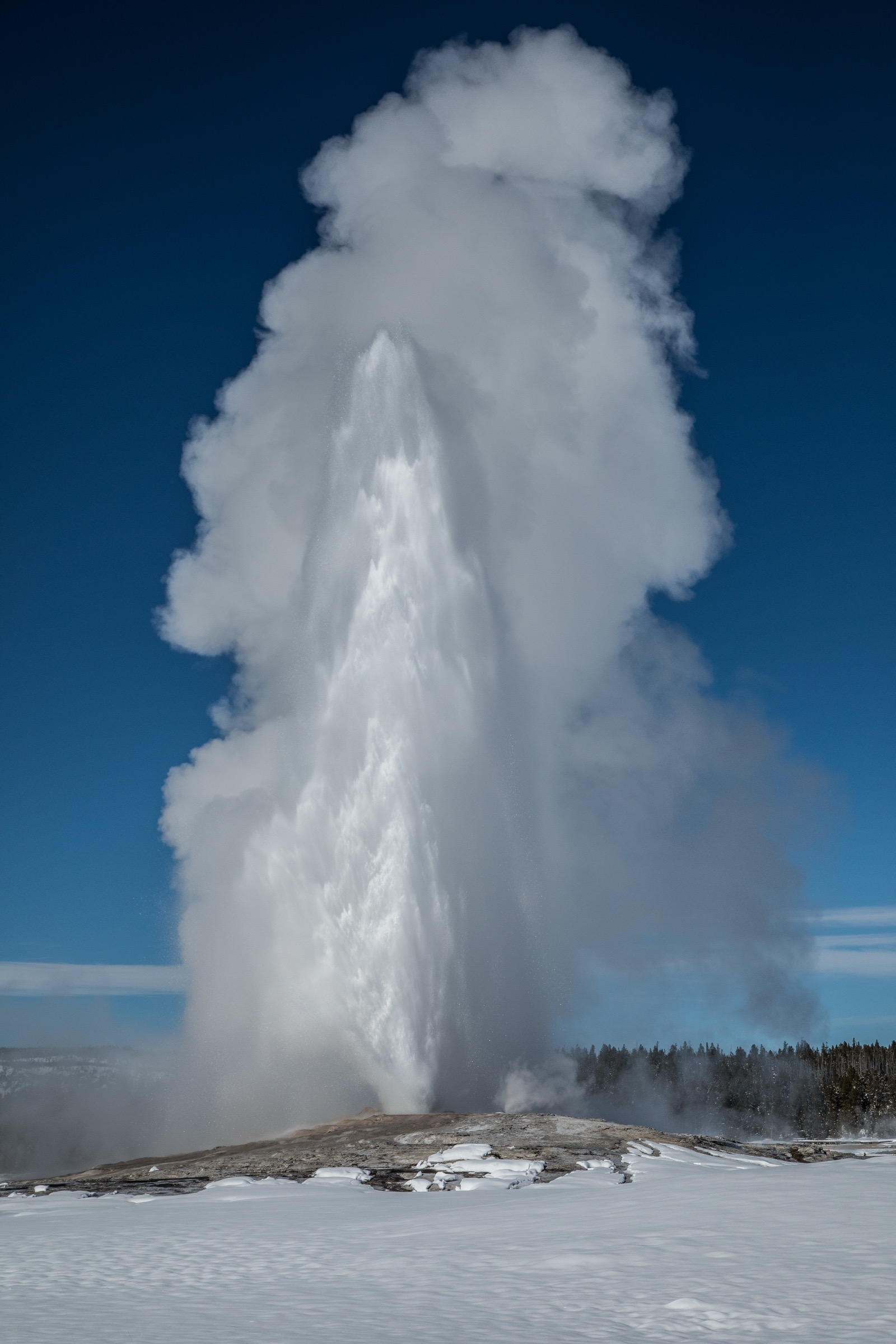
    A tall white column of water and steam erupts from a low pale mound and rises through most of the frame against a deep blue sky, its top spreading into a broad billowing cloud that drifts to the right. Inside the column a narrower, denser jet of water is visible, textured and streaked. The mound at its base is bare gray and tan, streaked with runoff, carrying small patches of snow, with thin steam rising from vents to its right. Flat unbroken snow covers the foreground and the middle distance. A dark band of snow-dusted conifers runs along the right horizon, and a pale hazy ridge lies low on the left.
    An eruption is the loud part. The quiet part is the ground it stands on: snow lies across the whole basin and up to the treeline, but the low mound around the vent stays bare, because heat is reaching the surface there and nowhere else in the frame. The column is water and steam, thrown up and blown downwind. Provisional caption — not yet confirmed by the photographer
  2. 02

    Engaging with the story

    10 min

    Show photographs 4 through 7 in order. Give students a specific job before you start. If the park came up in step 1, name it now and move on: Yellowstone National Park. Most will have heard of it. Very few will have connected it to energy.
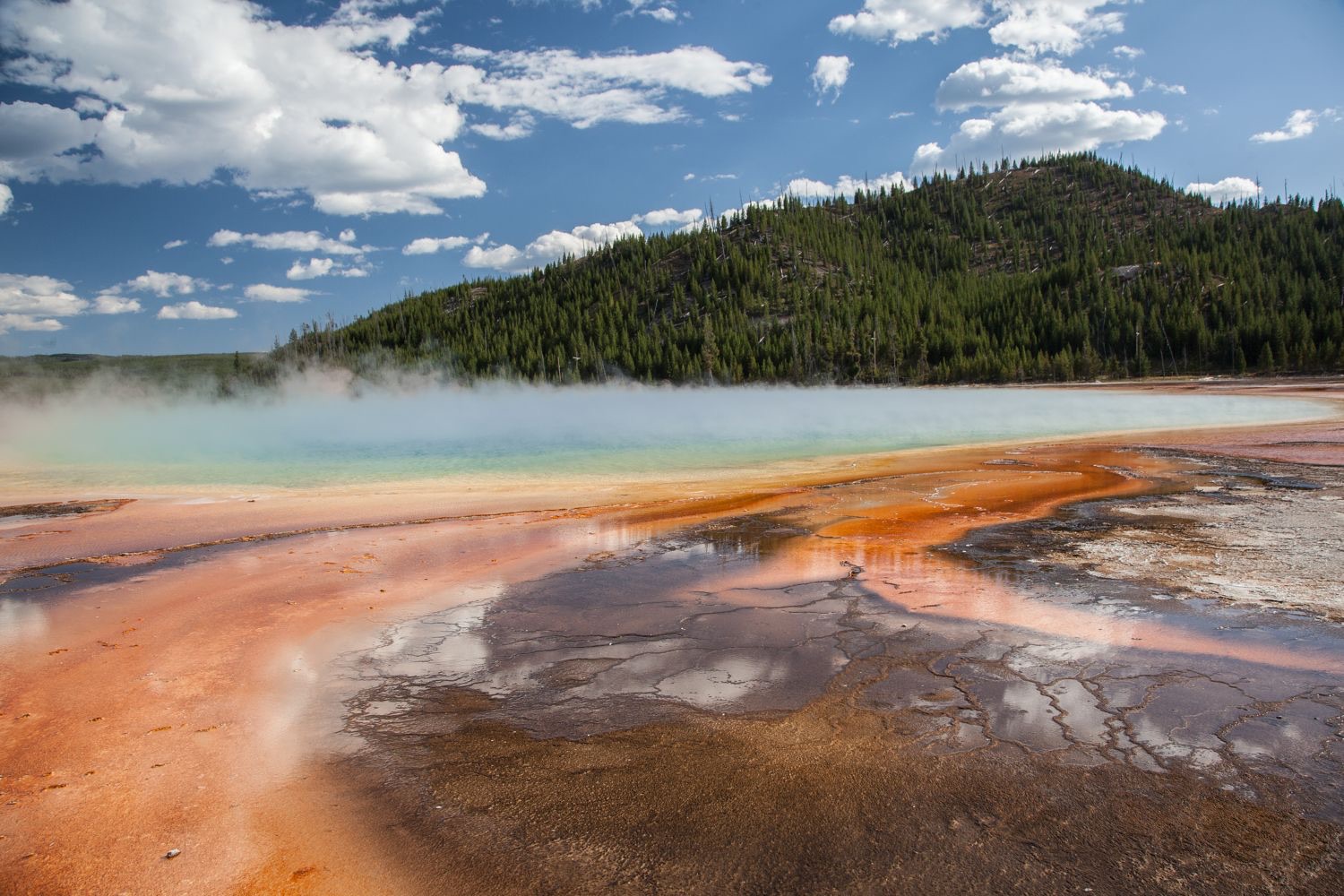
    A wide view. In the middle distance a broad pool of pale blue-green water steams heavily, with a low bank of white vapor drifting across it. In front of the pool the ground is covered in bands of orange, rust and brown microbial mat, cut by darker channels and shallow standing water that reflects the sky. Behind the pool a forested hill rises under blue sky with scattered cumulus cloud.
    Steam lifts off water hot enough to kill almost anything that falls in. The orange and brown bands in the foreground are microbial mats living in the cooler runoff. A lodgepole pine forest stands a few hundred meters away, entirely unbothered.
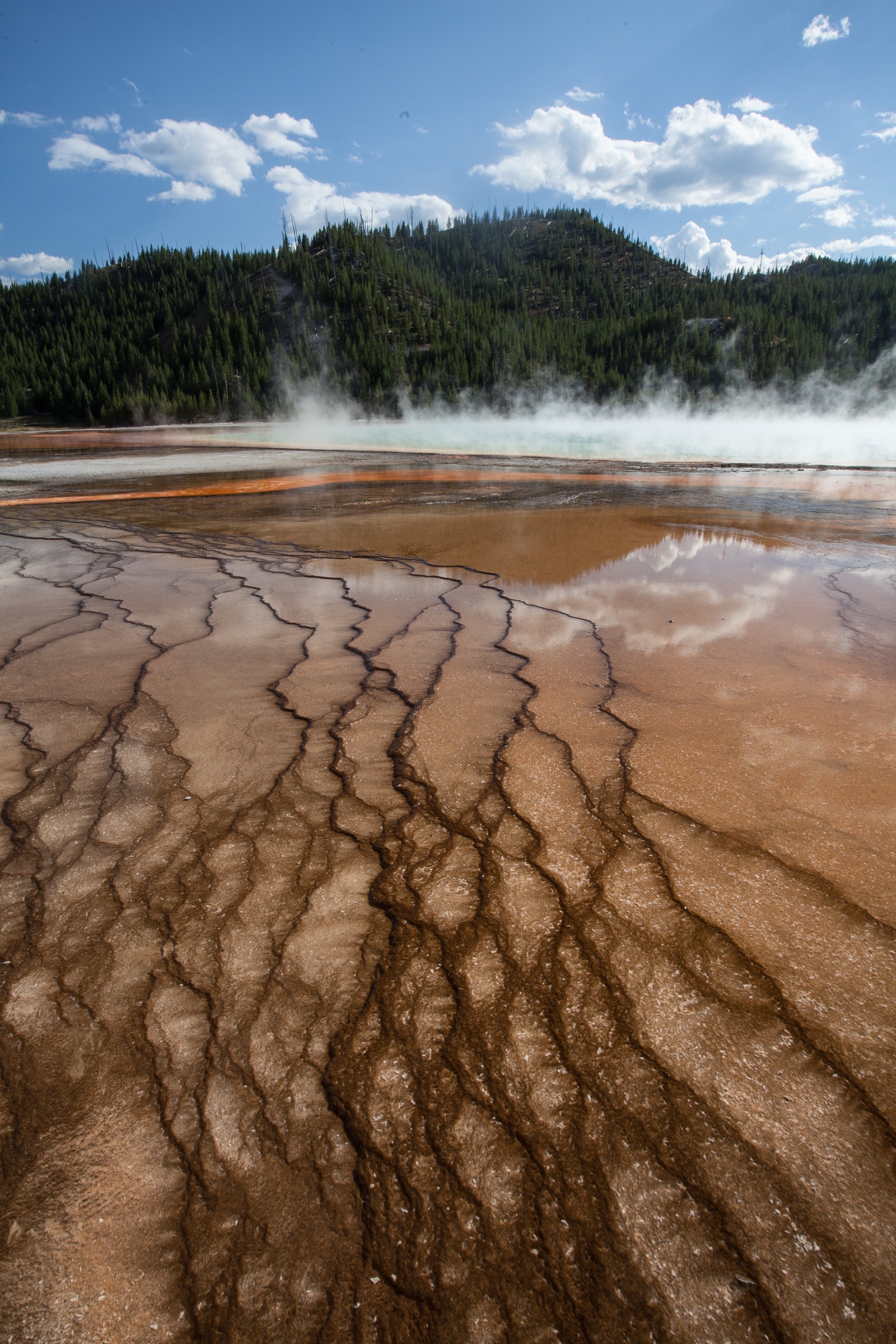
    A near-vertical view of a broad microbial mat in shades of tan, brown and orange, covered by a thin sheet of water. Dozens of dark narrow channels branch downhill across the frame in a pattern resembling tree roots or river tributaries. Beyond the mat, a steaming blue pool and a forested hill are visible under a blue sky.
    Close in on the runoff apron. The mat is not a smooth sheet. Water spreading downhill has cut a branching network of channels, and each channel carries slightly different temperature and chemistry, which is why the browns and oranges shift from ridge to groove.
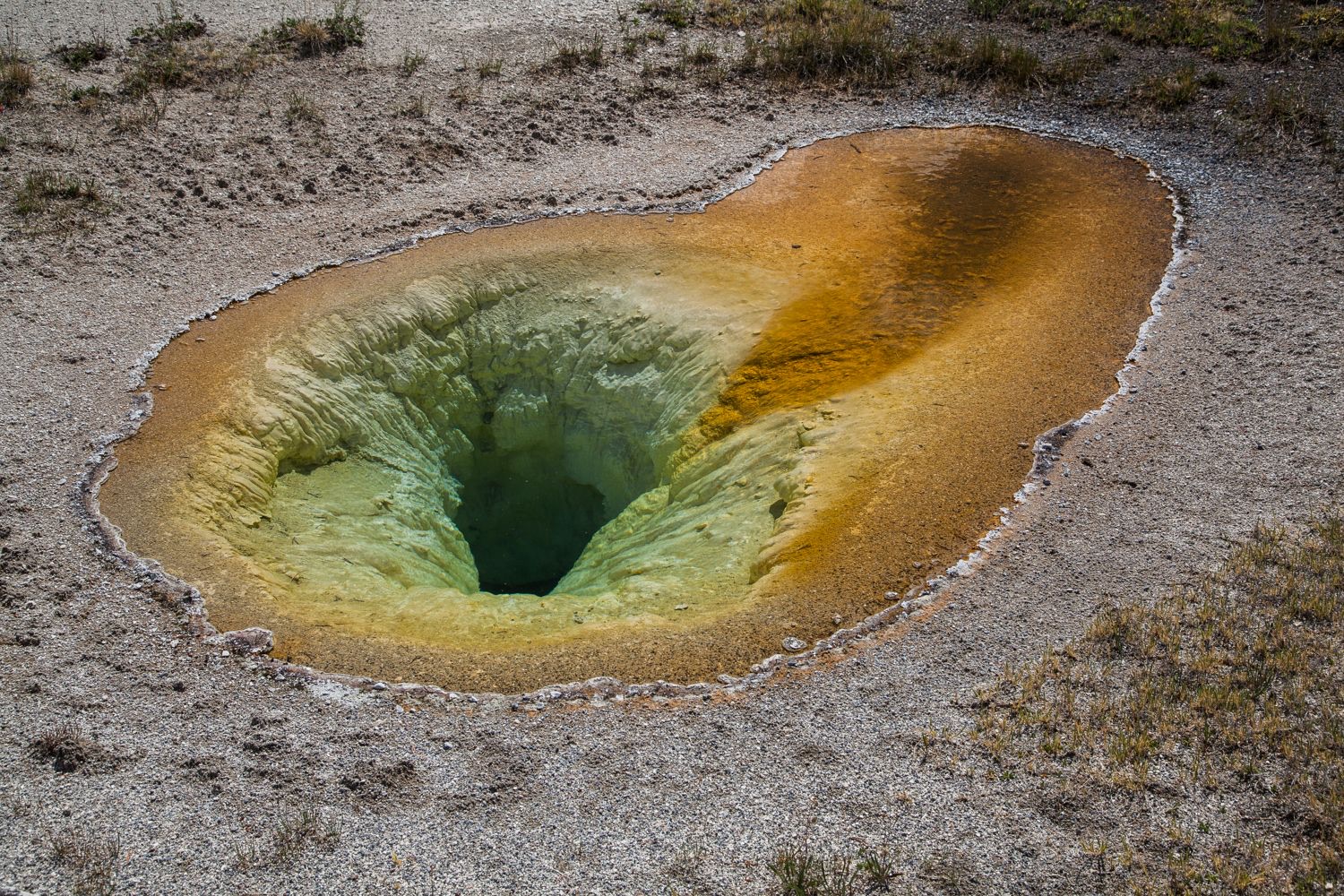
    An oval hot spring set in flat gray gravel. The near half is a funnel-shaped opening with ribbed yellow-green walls dropping into dark green water at the center. The far half is a shallow shelf covered in orange and mustard-colored mat under clear water. A thin crust of white mineral rims the whole pool. Sparse dry grass grows at the edges.
    A hot spring a short walk from the runoff channel. The throat drops away steeply and shifts from yellow-green to near black with depth. The rim carries the same orange mats, but here the water sits and cools slowly instead of running, and the result looks nothing like the channel.
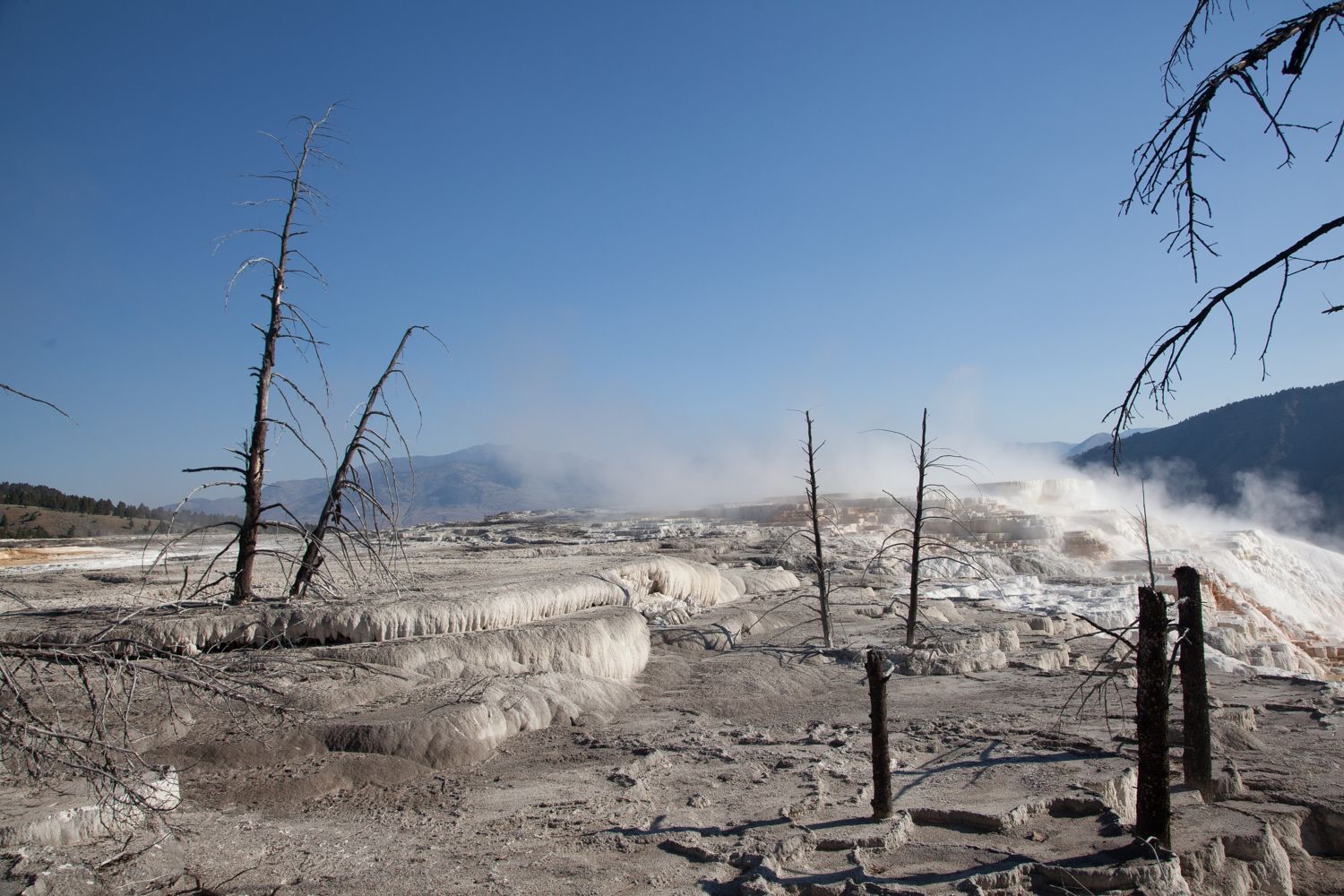
    A wide view of white and pale gray terraces built in overlapping ledges, with steam rising in the middle distance. Several bare dead trees stand upright in the terrace, trunks gray and branches broken. Two short blackened stumps stand in the foreground. Mountains and blue sky fill the background.
    The white steps are travertine, calcium carbonate dropped out of the water as it cooled. The dead trees give you the scale, and they also give you the story. This ground was forest until hot mineral water arrived, killed the trees, and began burying what was left of them.
  3. 03

    Working the evidence

    15 min

    The core of the investigation. Students work in pairs on the handout, using the Observe, Reflect, Question structure the Library of Congress developed for reading primary sources. A photograph is a primary source, and this is how it is done. Put photograph 3 on screen and leave it there.
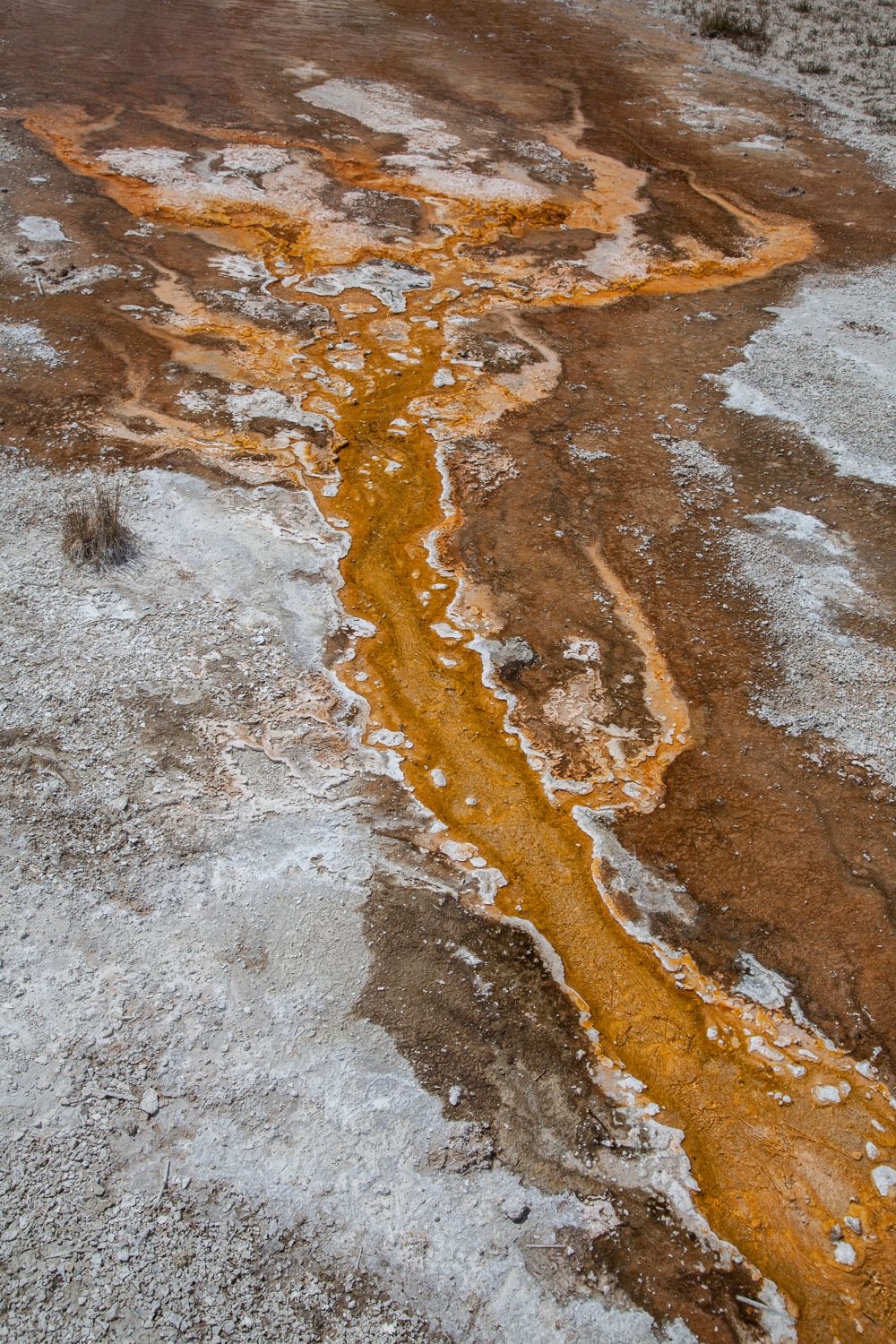
    Looking down on a shallow runoff channel. A vivid orange and gold band roughly a meter wide runs from top to bottom of the frame. It is bordered by crusted white and pale gray mineral deposit, and beyond that by flat brown and tan ground. Small white nodules line the channel edges. A single clump of dry grass sits at left.
    Hot water leaves a spring and runs downhill across white sinter. The bright orange stripe down the middle is not mineral. It is alive: mats of heat-loving microbes that survive only in a narrow band of temperature. The water is hottest in the channel and cools as it spreads, so the color of the ground is a rough map of temperature.
  4. 04

    Delving deeper

    10 min

    Now tell them what the orange is: living mats of heat-loving microbes, sorted along the cooling gradient, which makes the color of the ground a rough thermometer. Then hand out the data.

  5. 05

    Reflecting and projecting

    15 min

    The claim, evidence and reasoning assignment. Two parts. Both appear on the student handout as Part A and Part B.

The evidence

A tall white column of water and steam erupts from a low pale mound and rises through most of the frame against a deep blue sky, its top spreading into a broad billowing cloud that drifts to the right. Inside the column a narrower, denser jet of water is visible, textured and streaked. The mound at its base is bare gray and tan, streaked with runoff, carrying small patches of snow, with thin steam rising from vents to its right. Flat unbroken snow covers the foreground and the middle distance. A dark band of snow-dusted conifers runs along the right horizon, and a pale hazy ridge lies low on the left.

An eruption is the loud part. The quiet part is the ground it stands on: snow lies across the whole basin and up to the treeline, but the low mound around the vent stays bare, because heat is reaching the surface there and nowhere else in the frame. The column is water and steam, thrown up and blown downwind.
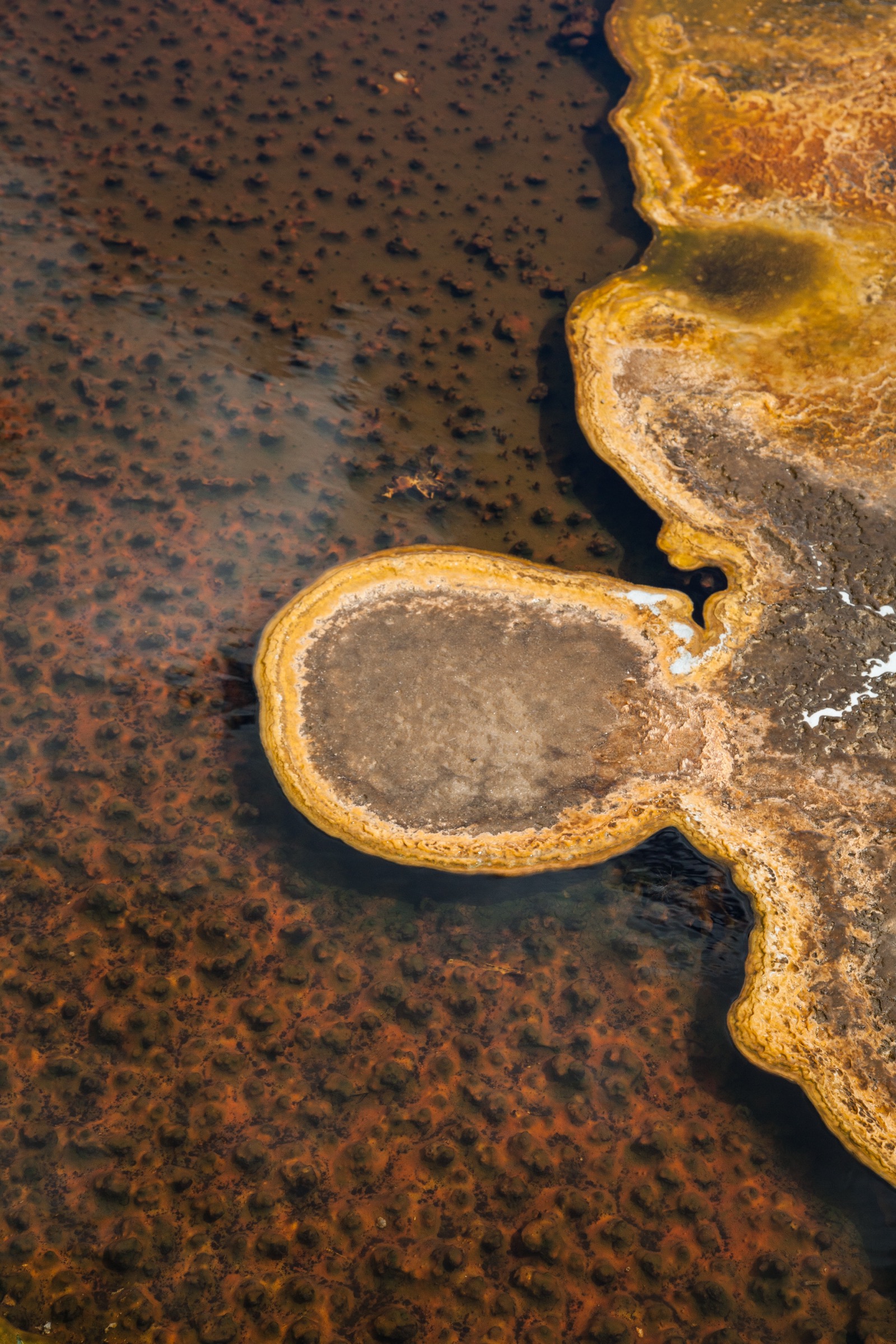
Location not yet confirmed · Greg Smith

Provisional caption — not yet confirmed by the photographer

Looking straight down at shallow clear water over a floor of dark rust, brown and olive, densely covered in small rounded lumps a centimeter or two across. Along the right side and top right a broad crust rises out of the water in overlapping scalloped lobes, pale gold and mustard at its outer edge and chalky gray-brown on its upper surface, with a few small bright white patches. Left of center an isolated oval of the same crust sits in the water, ringed by a raised gold lip and filled with a smooth pale gray-brown floor, joined to the larger mass at right by a narrow neck. A pocket of water at top right reads dark green. Nothing in the frame gives scale.

Two different processes, side by side in one frame. The rust-and-orange floor under the shallow water is mat — living, and lumpy at a scale you can see without a lens. The pale gold rim standing proud of the water is not alive: it is mineral, dropped out of solution at the edge where the water is shallowest and cools and evaporates fastest. The island near the middle is the same rim closed into a ring.

Location not yet confirmed · Greg Smith

Provisional caption — not yet confirmed by the photographer

Looking down on a shallow runoff channel. A vivid orange and gold band roughly a meter wide runs from top to bottom of the frame. It is bordered by crusted white and pale gray mineral deposit, and beyond that by flat brown and tan ground. Small white nodules line the channel edges. A single clump of dry grass sits at left.

Hot water leaves a spring and runs downhill across white sinter. The bright orange stripe down the middle is not mineral. It is alive: mats of heat-loving microbes that survive only in a narrow band of temperature. The water is hottest in the channel and cools as it spreads, so the color of the ground is a rough map of temperature.

Upper Geyser Basin, Yellowstone National Park, Wyoming · Greg Smith

A wide view. In the middle distance a broad pool of pale blue-green water steams heavily, with a low bank of white vapor drifting across it. In front of the pool the ground is covered in bands of orange, rust and brown microbial mat, cut by darker channels and shallow standing water that reflects the sky. Behind the pool a forested hill rises under blue sky with scattered cumulus cloud.

Steam lifts off water hot enough to kill almost anything that falls in. The orange and brown bands in the foreground are microbial mats living in the cooler runoff. A lodgepole pine forest stands a few hundred meters away, entirely unbothered.

Grand Prismatic Spring, Midway Geyser Basin, Yellowstone National Park, Wyoming · Greg Smith

A near-vertical view of a broad microbial mat in shades of tan, brown and orange, covered by a thin sheet of water. Dozens of dark narrow channels branch downhill across the frame in a pattern resembling tree roots or river tributaries. Beyond the mat, a steaming blue pool and a forested hill are visible under a blue sky.

Close in on the runoff apron. The mat is not a smooth sheet. Water spreading downhill has cut a branching network of channels, and each channel carries slightly different temperature and chemistry, which is why the browns and oranges shift from ridge to groove.

Grand Prismatic Spring runoff, Yellowstone National Park, Wyoming · Greg Smith

An oval hot spring set in flat gray gravel. The near half is a funnel-shaped opening with ribbed yellow-green walls dropping into dark green water at the center. The far half is a shallow shelf covered in orange and mustard-colored mat under clear water. A thin crust of white mineral rims the whole pool. Sparse dry grass grows at the edges.

A hot spring a short walk from the runoff channel. The throat drops away steeply and shifts from yellow-green to near black with depth. The rim carries the same orange mats, but here the water sits and cools slowly instead of running, and the result looks nothing like the channel.

Upper Geyser Basin, Yellowstone National Park, Wyoming · Greg Smith

A wide view of white and pale gray terraces built in overlapping ledges, with steam rising in the middle distance. Several bare dead trees stand upright in the terrace, trunks gray and branches broken. Two short blackened stumps stand in the foreground. Mountains and blue sky fill the background.

The white steps are travertine, calcium carbonate dropped out of the water as it cooled. The dead trees give you the scale, and they also give you the story. This ground was forest until hot mineral water arrived, killed the trees, and began burying what was left of them.

Mammoth Hot Springs, Yellowstone National Park, Wyoming · Greg Smith